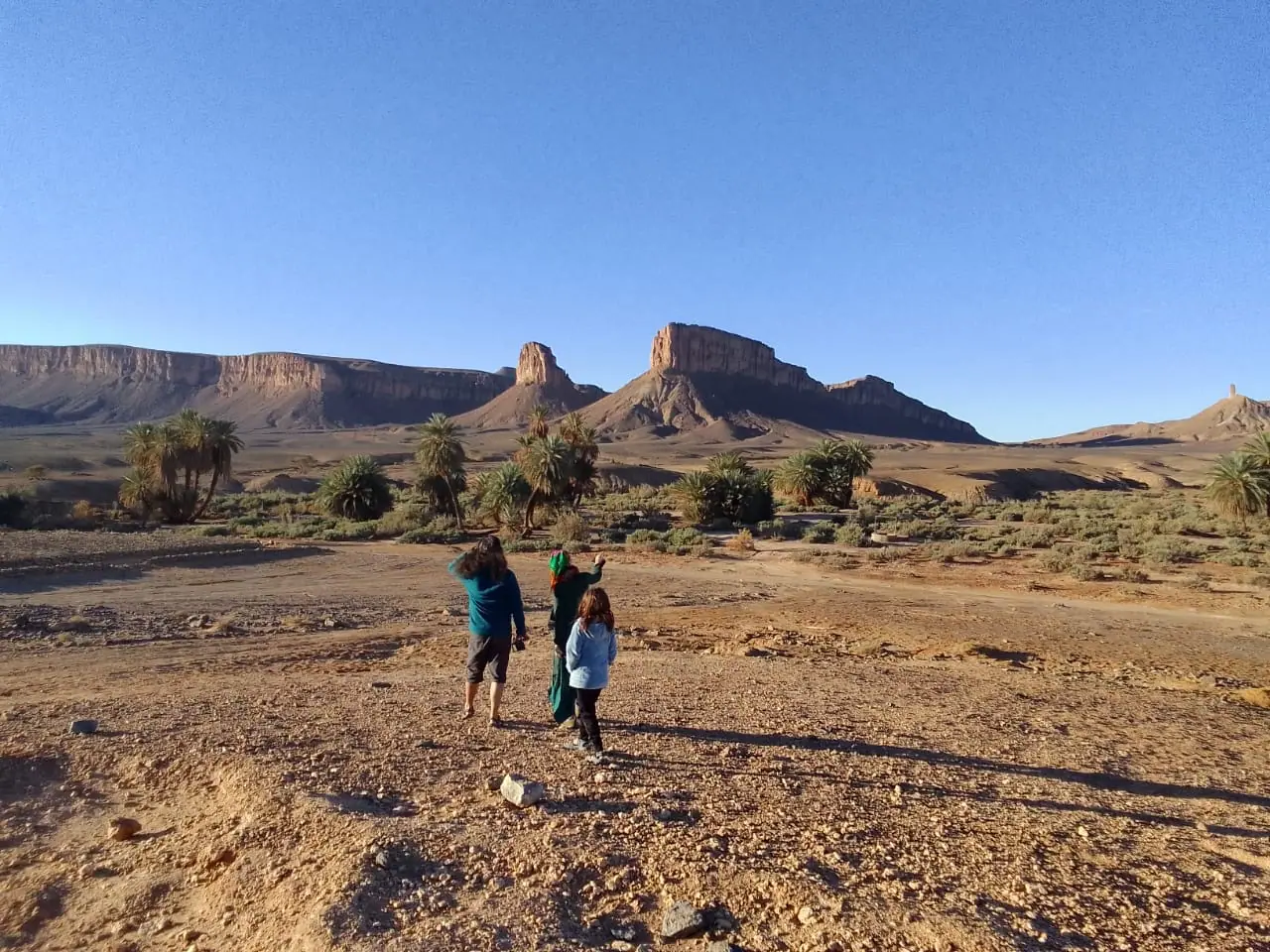
 Camel trek
Iriki National Park camel trek, 4 days
Dunes, a nomad oasis and an earth-built guesthouse in Iriki National Park, four days from Foum Zguid.
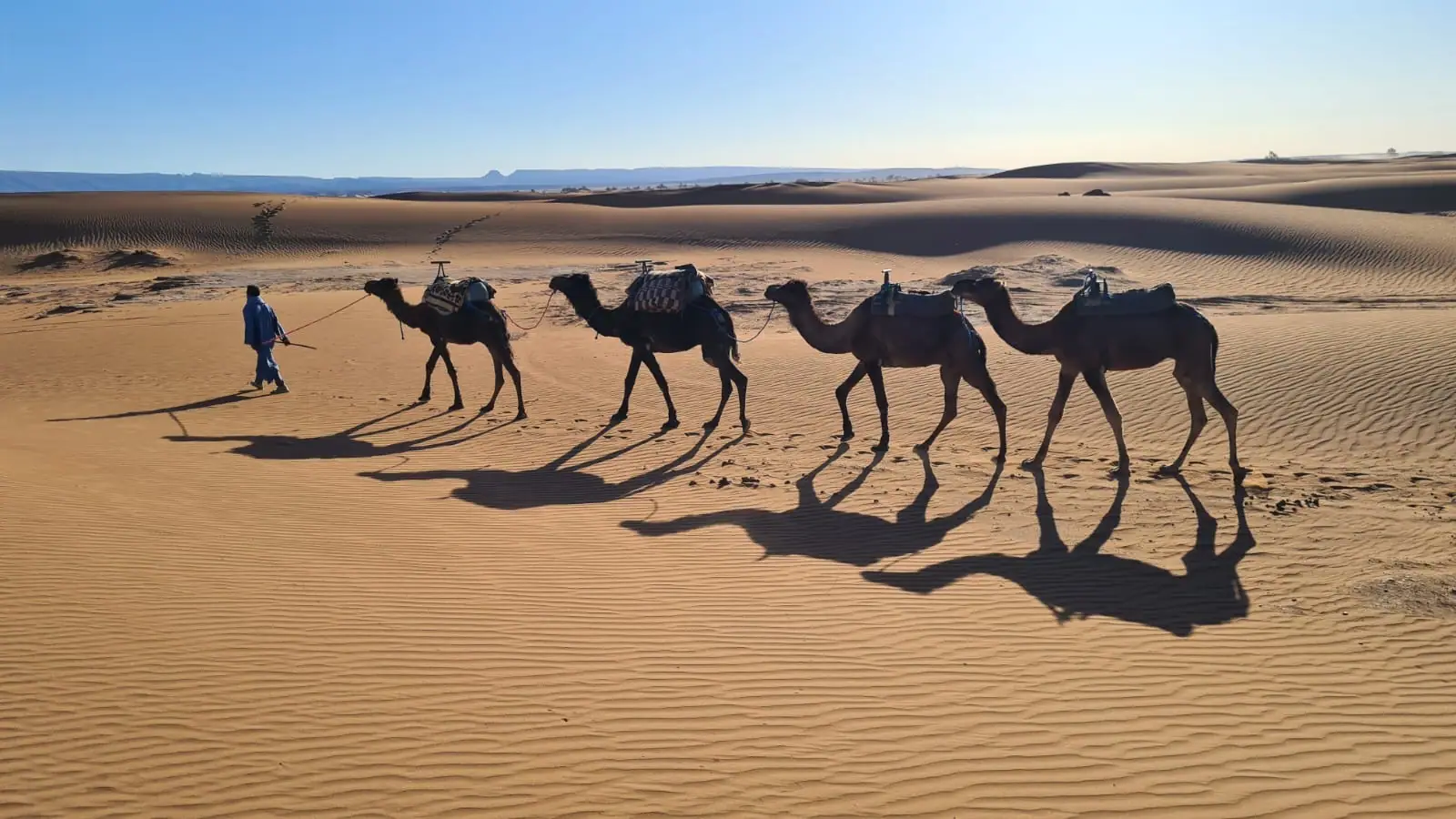
Collected in Marrakech or Agadir, you spend three days walking behind a camel caravan, dune field to dune field, ending among the palms of El Grisim. From €640 per person.
from€640per person
For travellers based in Marrakech or Agadir, this is the most complete way to go camel trekking in Morocco without organising anything yourself. The transfer is part of the trip: you are driven over the Atlas to Foum Zguid and on into the desert on the first day, and taken back to your city on the fifth. In between come three days on foot, from El Mhazil to the Elhaj Ahmed dunes and on to El Ghoule, then a last stage to the palm trees of the El Grisim oasis.
This is a proper walking trip. Count on roughly five to six hours a day, so it suits people who already hike and are happy in soft sand. The caravan carries the tents, food and bags, and you carry only a daypack; riding part of a stage can be requested if you need a rest. Nights are spent in dune camps and, at the end, beneath the palms. For something shorter from Foum Zguid itself, see the four-day Iriki camel trek, or plan the season with our camel trekking tips.
From Marrakech the road climbs over the Tizi n’Tichka; from Agadir it skirts the base of the mountains. The two routes meet at Tazenakht, then drop to Foum Zguid and out across the Iriki plains. By evening you reach Erg El Mhazil, where the first camp is set up and the caravan is ready for the morning.
After breakfast the equipment is loaded onto the camels and the caravan sets off. This is the first real trekking day, five hours or more at a steady walk through the sand, with stops along the way. Tonight’s tents go up in the sand of Erg Elhaj Ahmed, a second night out with the caravan.
A second long day of walking, with time to look closely at the desert as you go: tracks in the sand, the hardy plants, the colour of the dunes shifting through the day. In the evening the team lights a fire at Erg El Ghoule and the group gathers round it.
The final stage leaves the dunes for the El Grisim oasis. Here you see how sand bread is baked and how the tea ritual is carried out, then share dinner and sleep under the palm trees: a greener, more sheltered night after three in the dunes.
The 4×4 picks you up and crosses the Iriki plain back to Foum Zguid. After a break in Tazenakht the drive continues north and west to Marrakech or Agadir, depending on where you began, and the trip ends at your drop-off point.
If you walk regularly at home and can manage a long day on a hill path, yes. Sand is slower than a trail, so the pace is kept steady with breaks. If someone in the group tires, riding a camel for part of a stage can be arranged; say so in advance and the team will plan for it.
Both work, and the published price is the same. Coming from Marrakech you cross the High Atlas over the Tizi n’Tichka; from Agadir the road keeps to the foot of the range. The routes join at Tazenakht. Pick the city that fits your flights, and remember that hotel nights there are not included.
At the El Grisim oasis you are shown how bread is baked in the sand, alongside the ritual of preparing tea. It is one of the hands-on moments of the trek, on the fourth evening, just before dinner and your one night of the trip beneath the palm trees.
Camel trekDunes, a nomad oasis and an earth-built guesthouse in Iriki National Park, four days from Foum Zguid.
Camel trekFrom a riad in Foum Zguid to the Chegaga dunes and Erg El Ghoule, with short daily walks. From €640.
Camel trekThe shortest true camel trek: palm grove, Jebel Bani, El Mhazil dunes and Lake Iriki in three days on foot.
Write on WhatsApp with your dates, the number of travellers and the trip that tempts you. Nothing is booked until you agree.